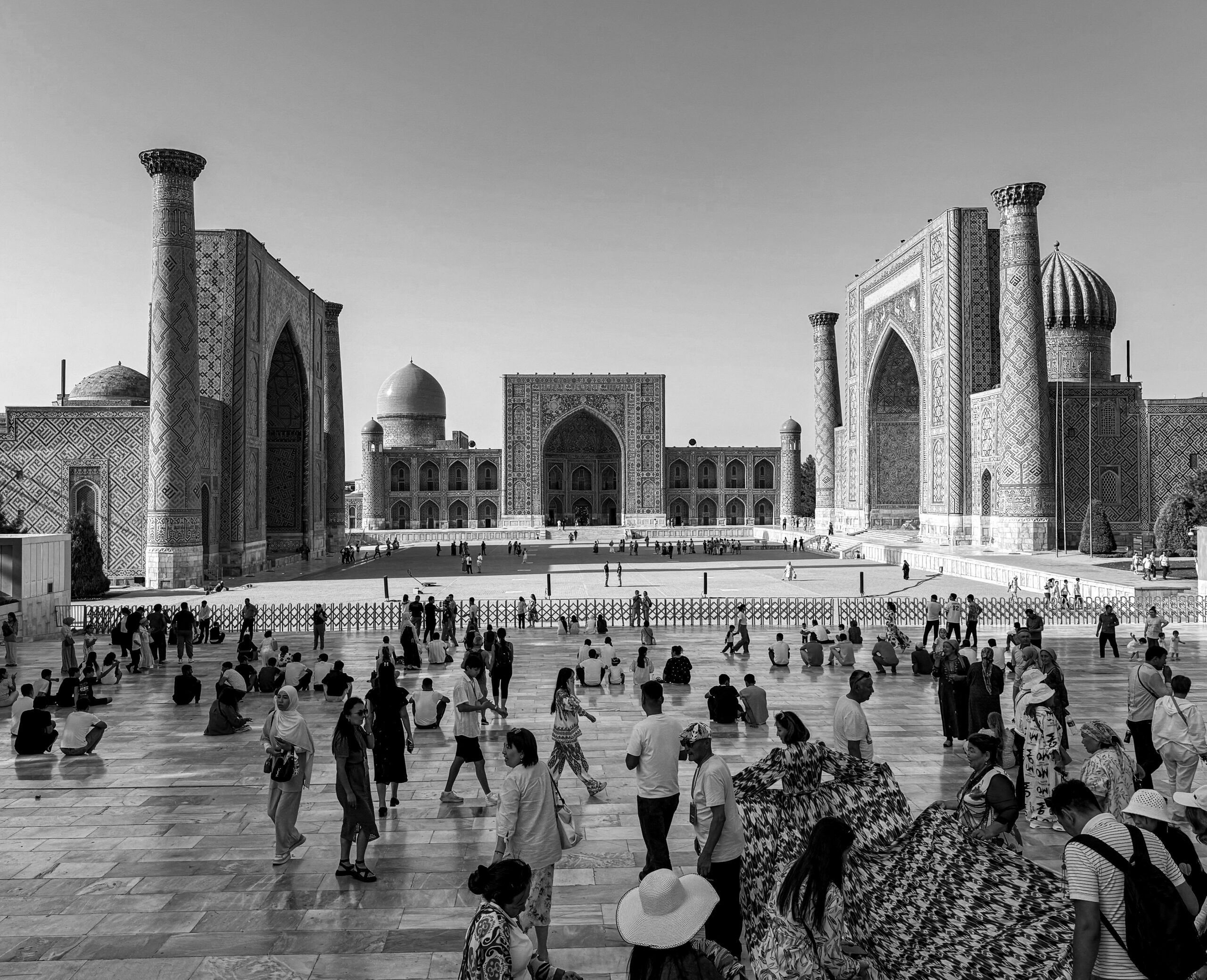
I reached the Registan in September 2025, at around seven in the evening. The sun was low, a few hundred people were crossing the square, and the three madrasas were changing colour by the minute. What stayed with me was not a single building but the mood: the time of day, the warm stone, the tiles catching the last light and then the first floodlights.
This is not a history lesson. It is a set of field notes for anyone who wants to photograph the Registan well: when to come, where to stand, how to manage without a tripod, and why I chose to show much of it in black and white.
Three buildings, one stage
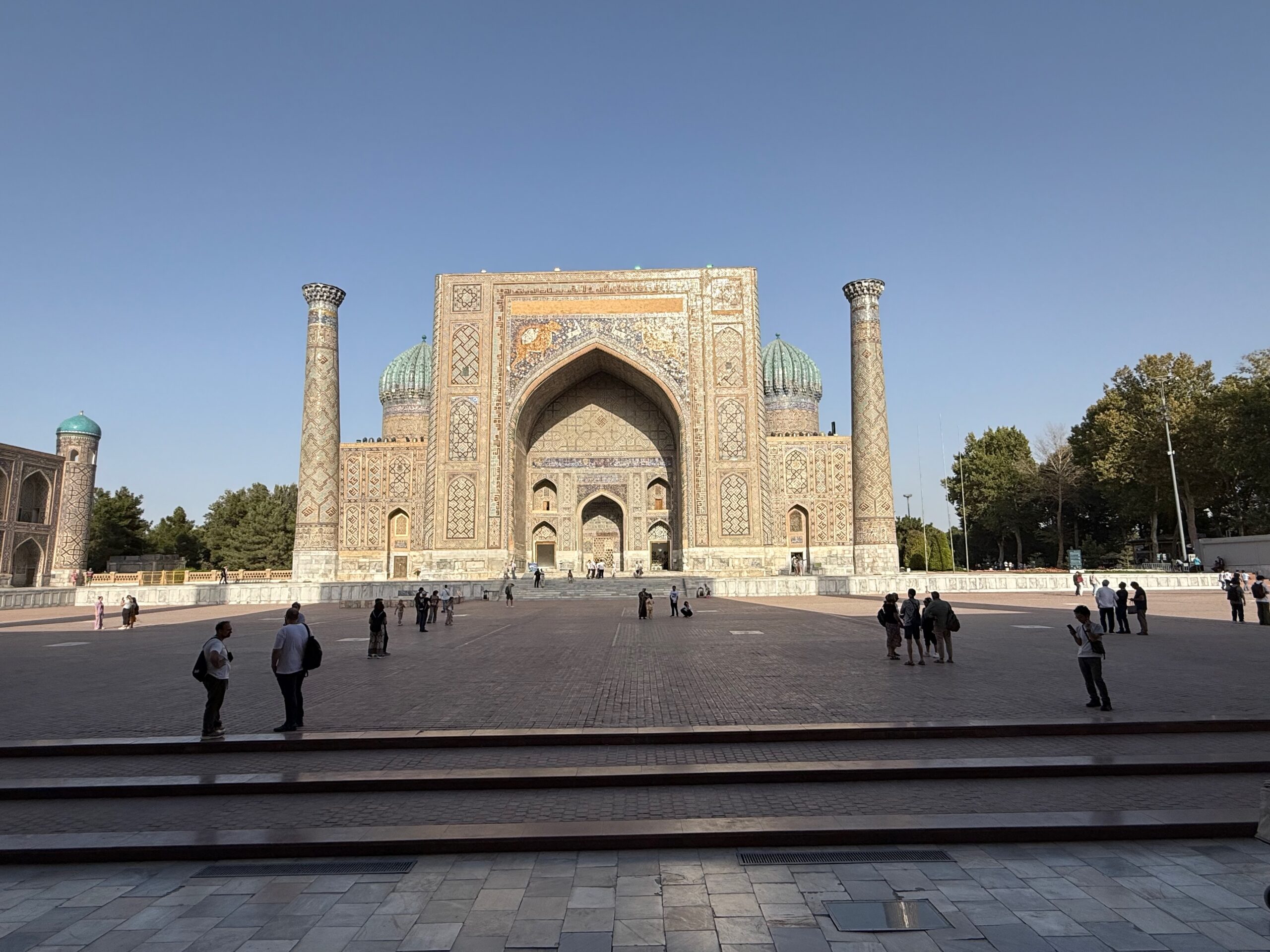
The Registan is framed by three madrasas built over more than two centuries: Ulugh Beg on the left (1417–1420), Sher-Dor facing it (1619–1636) and Tilya-Kori closing the square between them (1646–1660). Seen from the front, they form an almost perfect stage: three portals, paired minarets, domes rising behind.
For a photographer drawn to geometry, it is hard to find a better subject. Every facade is built from repetition: arches within arches, and tile patterns that repeat from the scale of a whole portal down to a single star in the mosaic.
Why the evening
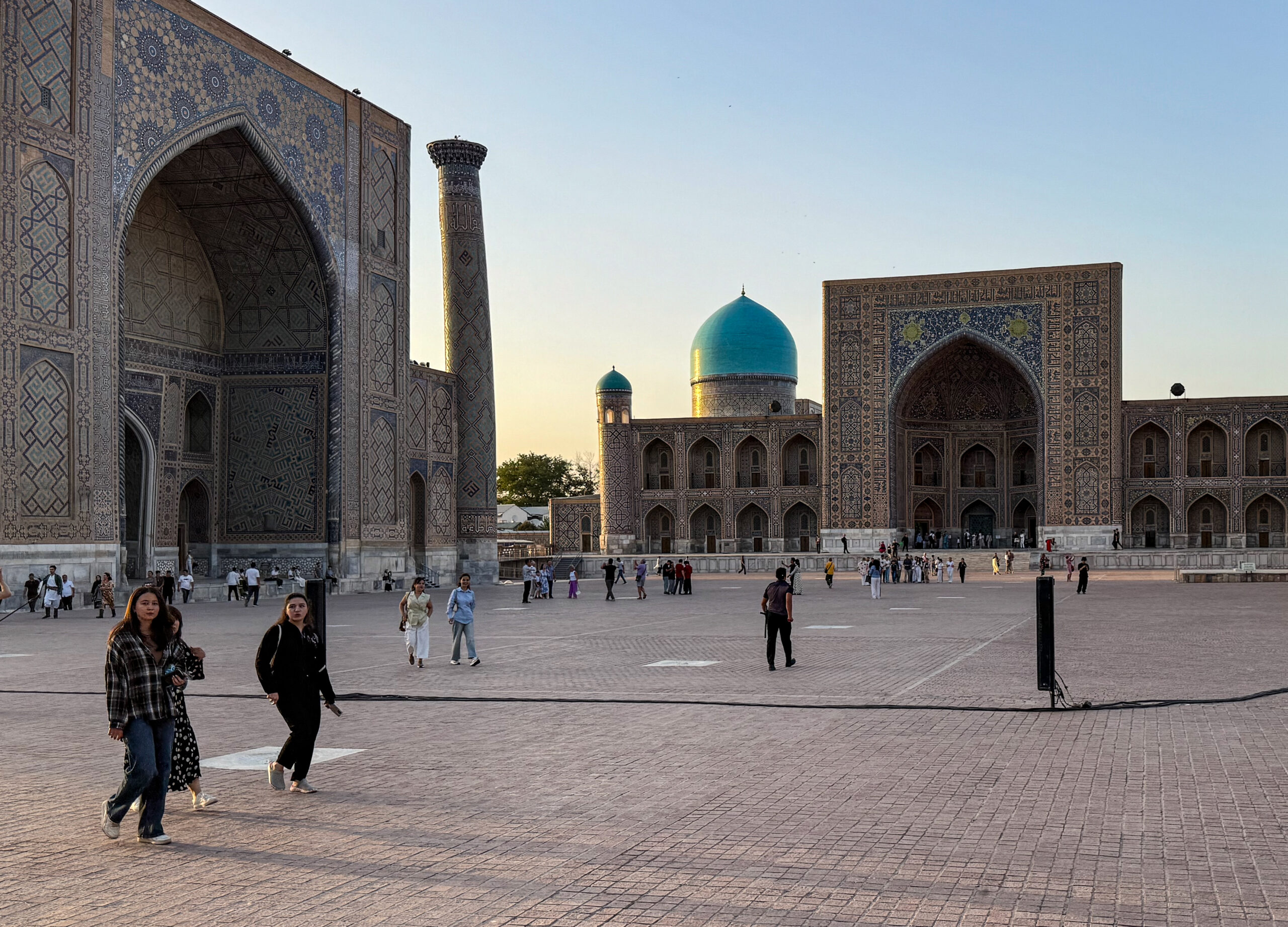
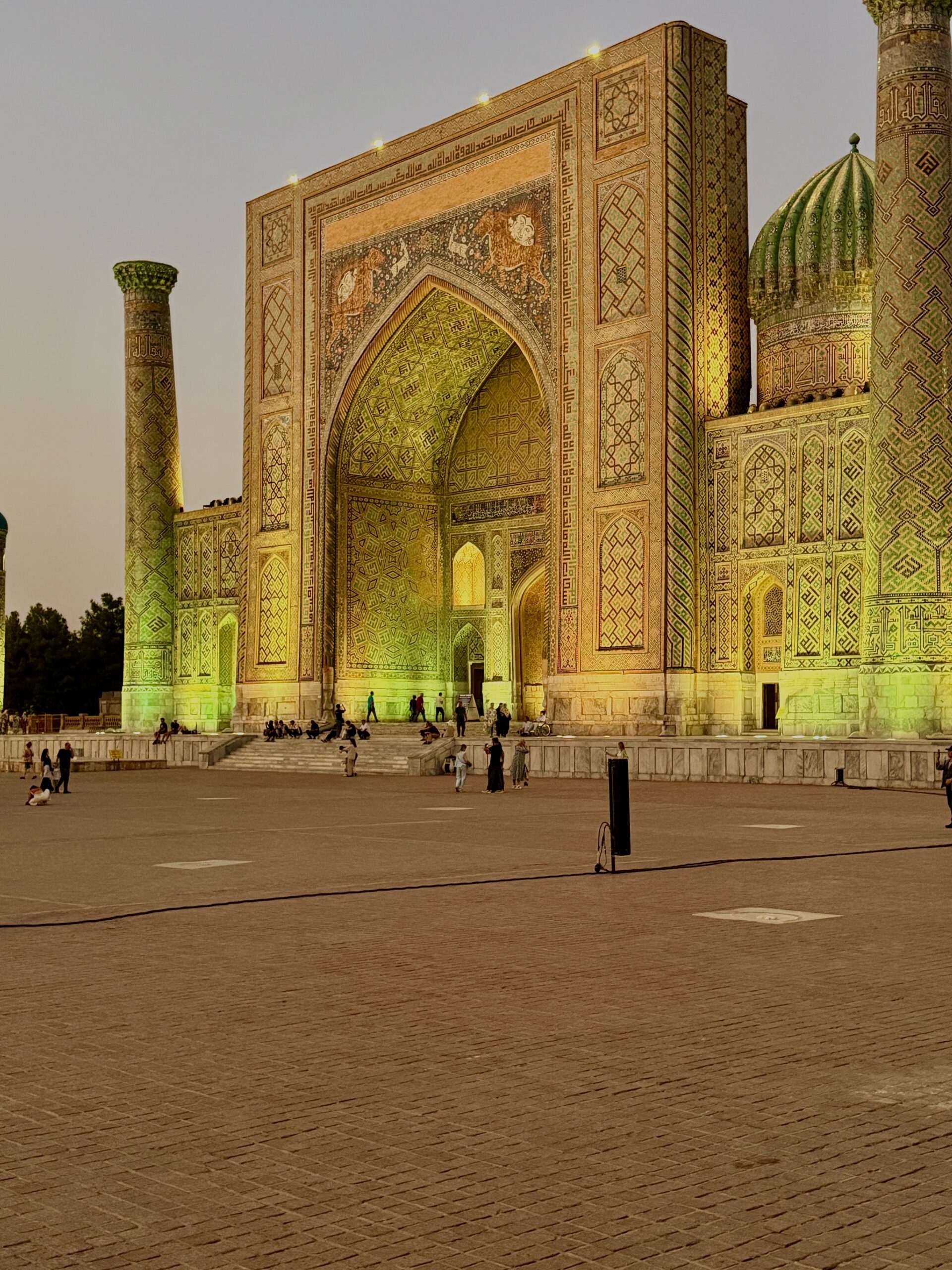
Arriving around seven in September, I caught the square in transition. The low sun warmed the facades, the shadows under the arches softened, and as the light faded the floodlights came on. Within an hour the same buildings looked like three different places.
- Late afternoon: warm, directional light on the facades and long shadows inside the arches.
- Sunset: the tilework glows while the sky still holds colour.
- Blue hour: floodlit tiles against a deep blue sky, the most photographed moment of the day, and for good reason.
The evening is also when the square is busiest: families, tour groups, wedding shoots. If you want an empty square, come early in the morning. If you want atmosphere, come in the evening and make the crowd part of the picture.
Where to stand
1. The classic front view. From the edge of the square facing Tilya-Kori you can fit all three madrasas into one frame. Keep the camera level and centred: here the symmetry is the whole point. A standard zoom at its wide end is enough.
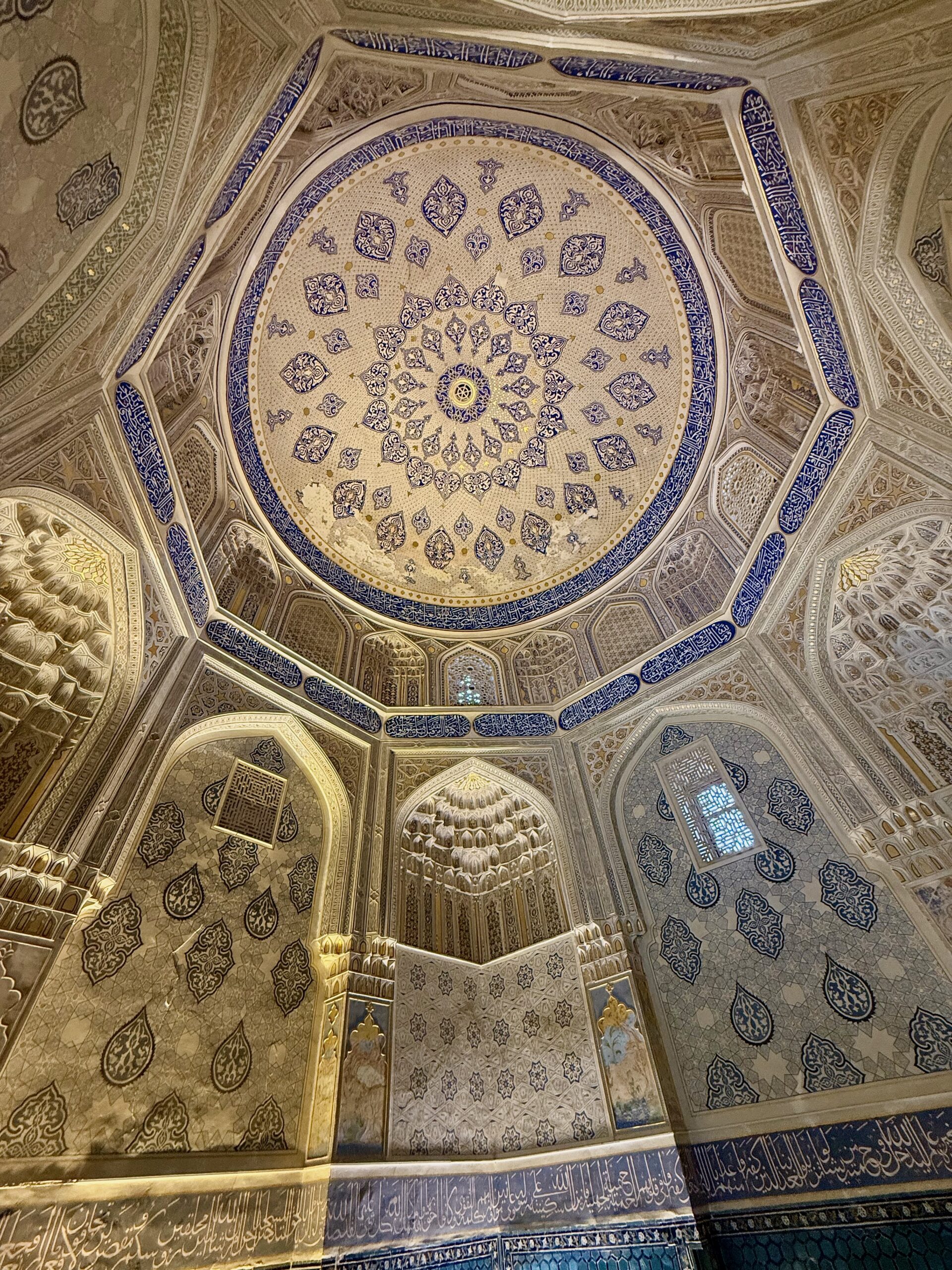
2. Details and pattern. Zoom in to isolate one section of tilework, the edge of a portal against the sky or a vaulted ceiling. These quiet, graphic frames often make the strongest prints.
3. One facade at a time. Step closer to a single madrasa and let the facade fill the frame. The steps and the people on them give the architecture its scale.
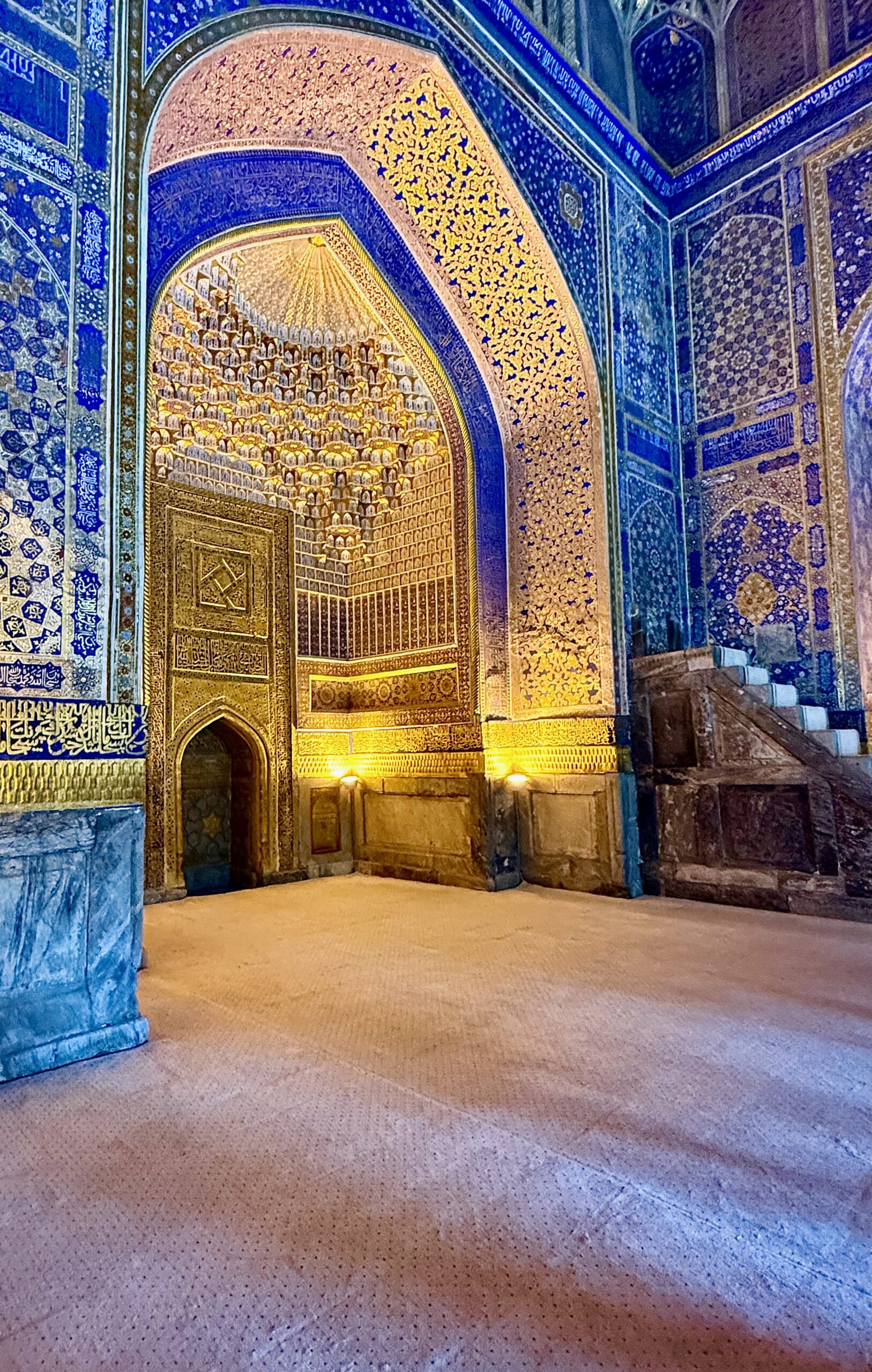
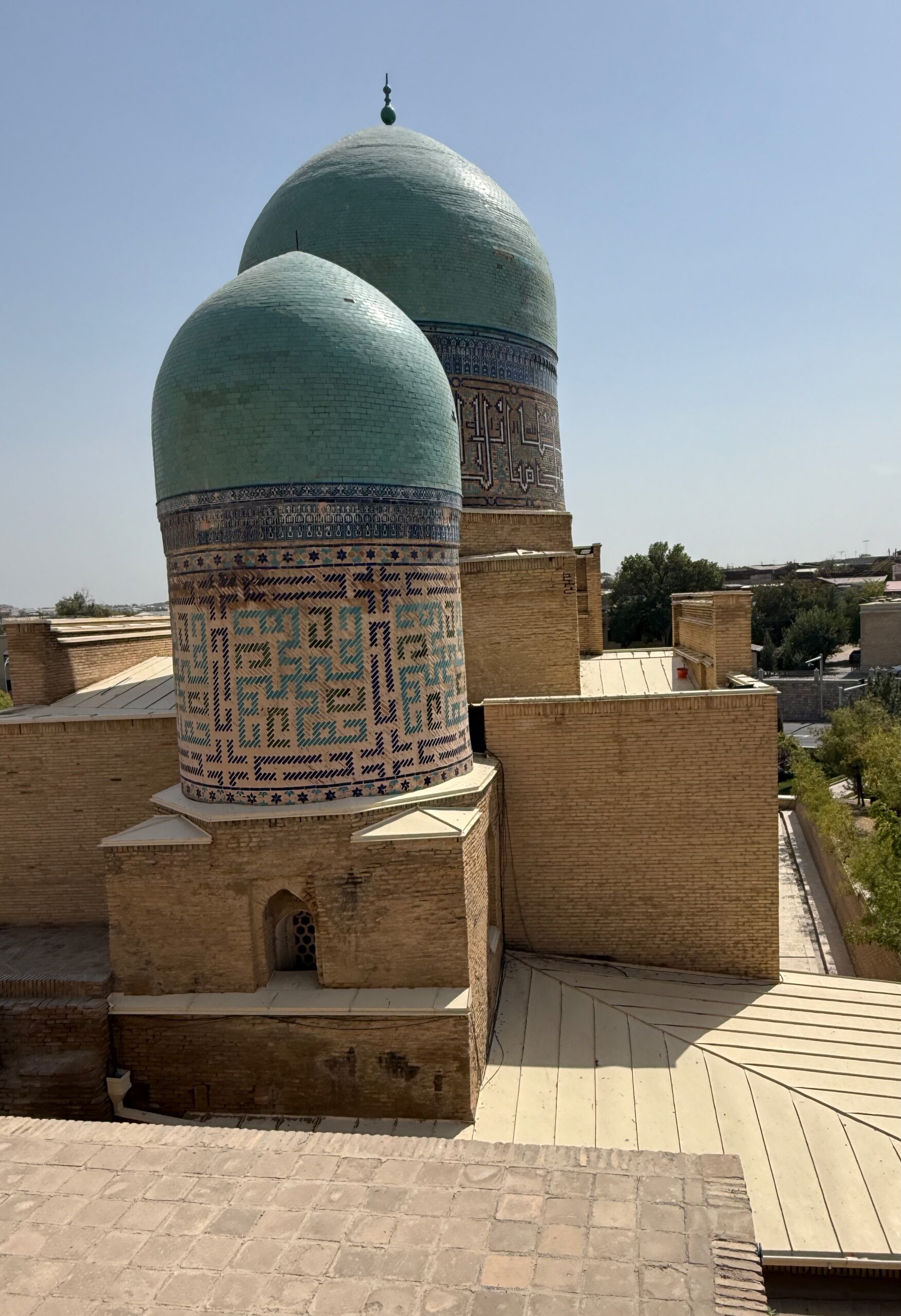
4. Domes and ceilings. Interiors are dim. Raise the ISO rather than hunting for somewhere to put a tripod.
Shooting without a tripod
I didn’t carry a tripod, only the camera and a standard zoom, and the evening light was still workable. A few things help:
- Raise the ISO before you drop the shutter speed. A little noise is far easier to live with than a blurred frame.
- Brace yourself against a wall, a column or the low barrier around the square.
- Stay at the wide end of the zoom, where camera shake shows least.
- Shoot a short burst. One frame is usually sharper than the rest.
- Expose for the bright tiles and lift the shadows later.
Tripods may need permission at ticketed sites, and the square is crowded in the evening anyway, so travelling light is a reasonable choice.
Why black and white
Most people photograph Samarkand for its blue. I chose to show many of my Registan photographs in black and white because I want to show these places in different tonalities, and to leave the colours to the viewer. Without colour, the tilework becomes texture and the madrasas become pure architecture: light, shadow and rhythm. The viewer imagines the turquoise and the gold for themselves, instead of having them imposed by the photograph.
Practical notes
- Season: spring and autumn are the most comfortable. September evenings are warm and the light is soft.
- Tickets and hours: entry to the madrasas is ticketed, and prices for Samarkand’s main monuments have risen in recent years. Check the current price and opening hours at the ticket office and keep some cash in small notes.
- Crowds: the evening is busy. Use people as scale, or wait for a gap.
- Respect: ask before photographing someone up close, especially at wedding shoots, and be discreet near places of prayer.
- Getting there: the Afrosiyob high-speed train from Tashkent takes a little over two hours. Book ahead in high season.
- Gear: a camera with a standard zoom is enough. A tripod is optional.
See the series
The photographs from this trip, from Samarkand, Bukhara, Khiva and Tashkent, are collected in the Uzbekistan gallery. Several of them are available as fine art prints: see how to order a print.
If you enjoy quiet, geometric architecture, the Quiet Geometry series takes the same way of seeing to other cities.