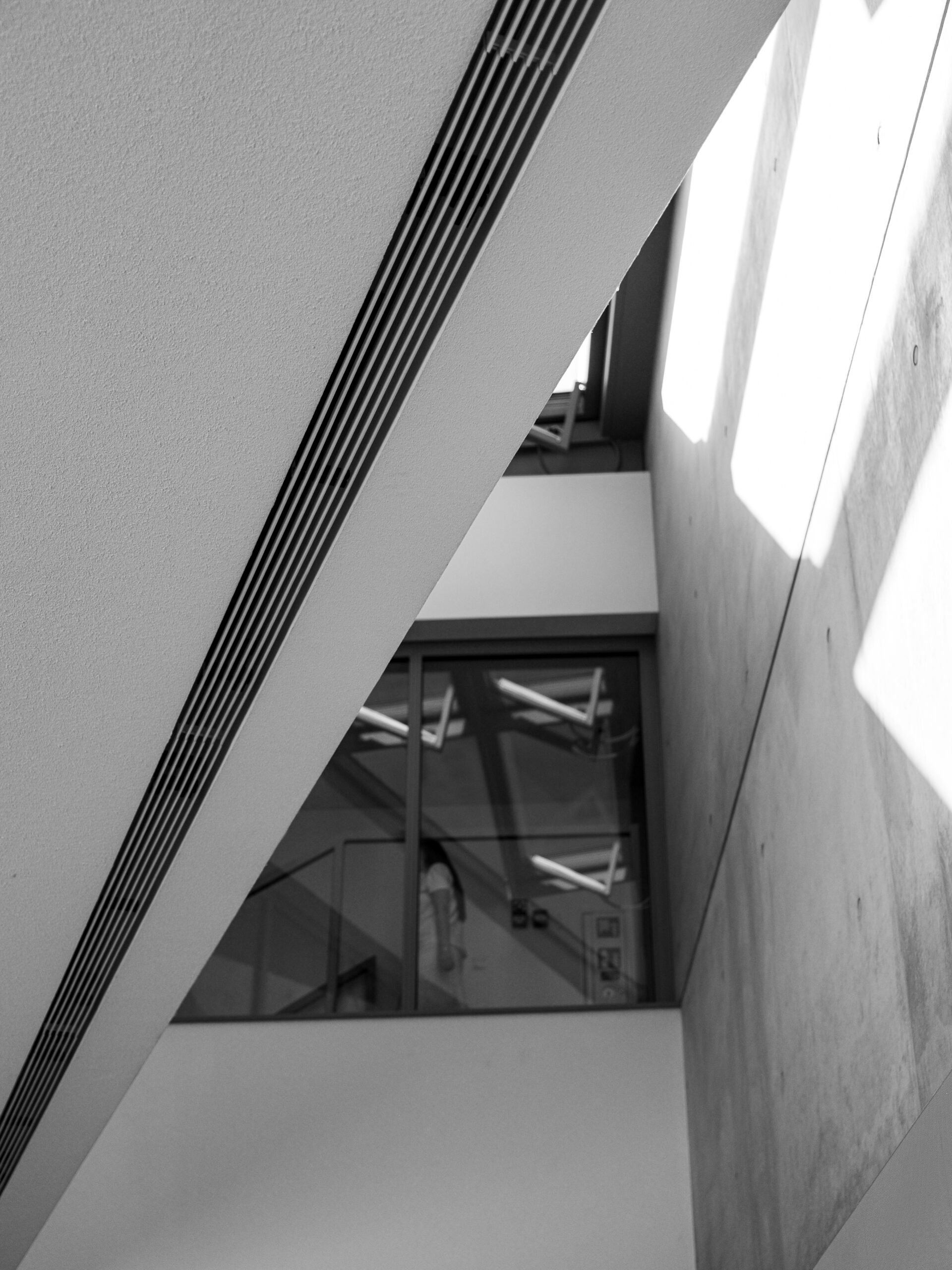
Light Shaft is one of the photographs in my series Quiet Geometry. I took it in August 2026 at the Manggha Museum of Japanese Art and Technology in Kraków, around midday.
What made me stop
Three things: shape, light and composition. They are the reason I raise the camera in almost every photograph of this series, and here all three met in one place. The building gave the shapes, the midday sun gave the light, and my only task was to find the frame in which they work together.
How it was made
I made a few frames, handheld, with my Fujifilm X-T20 and a standard lens. No tripod and no special equipment — just walking, looking and waiting for the frame to settle into place.
The black and white edit
In Lightroom, the most important thing for me was to bring out the depth of the tones and to keep the character of the composition. Black and white removes everything that could distract — what remains is light, shadow and form.
What silence in architecture means to me
Silence in architecture is a state of pause, reflection and calm. Despite the shapes and closed figures, our mind is not confined by them — imagination leads us on to the next place, adding its own interpretation and feelings.
That is what I look for in buildings, and what I hope a viewer finds in this photograph: not a record of a place, but a moment of stillness that opens somewhere further.
About the place
The Manggha Museum stands on the bank of the Vistula, across the river from Wawel Castle. The building was designed by the Japanese architect Arata Isozaki and opened in 1994 — a piece of Japan in the middle of Kraków, and a very good place to photograph quiet geometry.
See more and order a print
You can see Light Shaft together with the other photographs of the series on the Quiet Geometry page. If you would like it on your wall, here is how to order a print.